
2026 will usher in the Chinese Year of the Horse — more precisely, a Yang Fire Horse year. The Chi (vital energy) associated with this cycle blends the dynamic qualities of Yang Fire with the Fire (and a touch of Earth) naturally embedded in the Horse zodiac sign. The last Horse year occurred in 2014, and the next will arrive in 2038, as each animal of the Chinese zodiac returns every 12 years.
So, when does the Chinese New Year begin in 2026? The Year of the Horse commences on 17 February 2026 according to the lunar calendar.
But is that the whole story? Not quite. The Chinese metaphysical system and traditional calendar are always a bit intricate—and far more precise—than they might initially appear. You’ve likely noticed that the date of the Chinese New Year shifts annually, unlike the fixed Western New Year. This may seem unusual until you understand its basis. The New Year is calculated through the lunar (moon) calendar, yet Chinese tradition actually follows a dual-calendar system that incorporates both lunar and solar calculations. The solar date does not match the lunar date, and the combined system is known as the Hsia (Xia) or farmers’ calendar.
In this article, I will outline each of the dates associated with the 2026 Chinese New Year and clarify the astrological and astronomical reasoning behind these time markers. You will then understand when the energy of the Horse year actually begins—and why celebrating it, even if you aren’t Chinese, is meaningful. Let’s break down the lunar and solar calendars to see when the Year of the Yang Fire Horse truly starts.
When does the Yang Fire Horse year of 2026 actually begin?
The shifting date that defines the start of a Chinese year follows the lunar cycle. It takes roughly 29.5 days for the moon to complete one full orbit around Earth, which forms a lunar month. Twelve lunar months make up a lunar year:
12 × 29.5 = 354 days.
As you’ve certainly inferred, 354 days is shorter than the 365 days that form a solar year. This discrepancy explains why the Chinese New Year falls on different dates annually. To correct the shorter cycle, an additional lunar month is inserted approximately every three years. This “intercalary” or leap month accounts for the 11-day difference between lunar and solar years. After three years, the gap becomes about 33 days, nearly the length of a lunar month, so that’s when the extra month is added. Thanks to this adjustment, the lunar and solar calendars never drift too far apart. Years containing this additional month are considered leap years. I hope you’re still with me.
According to the lunar system of 354 days…
The lunar beginning of the Yang Fire Horse year falls on 17 February 2026.
This date follows the moon cycle and represents the first key marker.
As Chinese metaphysics considers both Yin and Yang influences, the solar cycle is also essential. The solar start of the Chinese year is based on a standard 365-day solar year, yet it does not coincide with the solstices. It follows a different logic, which I’ll explain shortly. This solar beginning usually lands on the 3rd, 4th, or 5th of February.
For 2026, the solar start of the Yang Fire Horse year is 4 February 2026. This is the second important date, calculated according to the movement of the sun.
This solar date is the one used for certain Chinese metaphysical practices such as Bazi, Feng Shui, and Qi Men Dun Jia, which is also the basis of my membership work.
So when is a child considered born in the Year of the Horse? Since Bazi (the Four Pillars of Destiny) is a solar-based astrology, a baby born on or after 4 February is classified under the Horse sign. Those born between 4 February and 17 February 2026 fall into the Horse year—unless a practitioner uses a lunar-based Bazi system, which is far less common.
Now that you know about these two dates, you might wonder what relevance they have to your life—especially if you come from a non-Chinese culture.
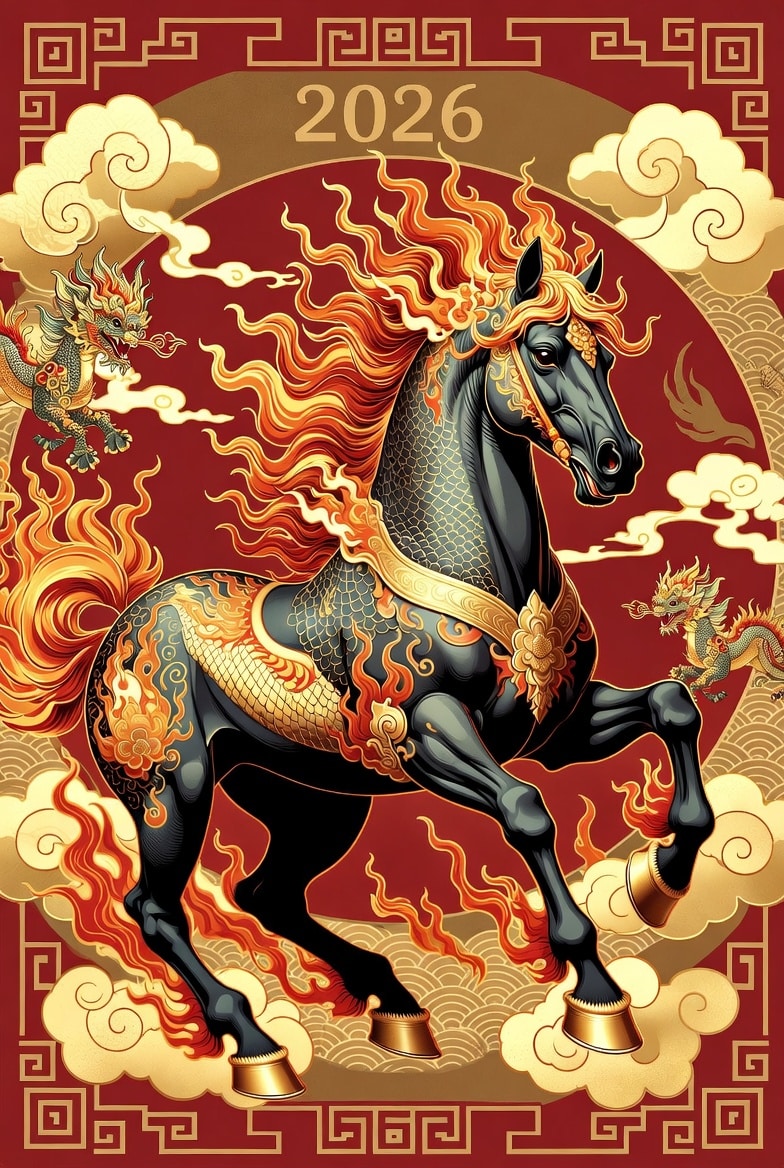
The Fire Horse is coming. Image created with Grok
I’m not Chinese. Why would I celebrate the Chinese New Year?
Simply put, from an astrological and astronomical standpoint, the Chinese New Year aligns more naturally with cosmic rhythms. The Western New Year on 1 January is mostly a societal convention. That does not mean cultural traditions lack influence—they do, forming part of the “human” aspect of the Taoist Three Luck (the cosmic trinity). Yet such conventions evolve over centuries, reflecting human decisions rather than celestial patterns.
In fact, for a long stretch of Western history, the year began on 1 April—and I promise I’m not joking! The shift to 1 January arose from human authorities attempting to impose structure over natural cycles. Given the amount of manipulation historically practiced by ruling elites—including through ritualistic acts—choosing a date that is not in harmony with natural cosmic order doesn’t help us live in alignment with universal energies.
A year that begins according to planetary motion, however, follows a very different philosophy: one recognizing that forces greater than human will shape our experiences, and that respecting these forces brings us into equilibrium with the cosmos.
In short: the Western New Year reflects a control-based, administrative decision, whereas the Chinese New Year is grounded in natural law.
To see how arbitrary 1 January really is from an astronomical point of view, consider ancient civilizations. Mesopotamians, Egyptians, Greeks, and Celts all chose year-start dates tied to equinoxes and solstices:
-
Vernal equinox (around 20 March)
-
Autumn equinox (around 20 September)
-
Winter solstice (around 20 December)
Even the Romans marked their new year around 1 April, near the spring equinox. This remained the norm in Western calendars for centuries. The tradition eventually morphed into April Fool’s Day, but the actual reset of the year was moved to 1 January in 1582, when Pope Gregory XIII introduced the Gregorian calendar. This decision reshaped Western timekeeping but had no connection with celestial or natural forces.
So, which dates best represent the start of a year? The solstices and equinoxes are certainly logical candidates. In the Northern Hemisphere, the Winter Solstice (now around 22 December) is the shortest day. From that point on, Yang energy begins to rise again, gradually strengthening until the peak of summer. One could easily argue that late December marks a natural beginning.
But the Chinese calendar chooses a different approach. The two dates marking the start of a Chinese year correspond to the moon beginning a new orbital cycle around Earth, and the Earth beginning a fresh solar cycle around the Sun. These shifts directly reflect real movements in energy.
To summarize, here are the Chi-changing transitions between September and February:
-
Autumn equinox (around 20 September)
-
Samhain/Halloween, midway between the equinox and winter solstice (31 October)
-
Winter/December solstice — after which Yang grows and Yin recedes
-
Lunar New Year, beginning on the new moon that starts the 11th lunar month
-
Solar New Year, when the Sun reaches exactly 315°, typically on 4 February (sometimes the 3rd or 5th), marking the start of astrological spring in Chinese tradition
While 1 January carries cultural significance and falls reasonably close to the solstice, it doesn’t represent an actual energetic shift. In contrast, the lunar and solar Chinese New Year markers correspond to genuine astronomical cycles. This is also why the energy of the Chinese New Year already starts to stir after the December solstice (as Yang begins to rise), and reaches its full transition with the lunar and solar thresholds. That said, the Western date remains useful for numerology, a metaphysical system rooted in human patterns.
By now you can see that the Chinese New Year dates symbolize an actual energetic transformation, whereas the Western date reflects social structure more than cosmic flow. So, returning to the central question: Why celebrate the Chinese New Year?
Because to cultivate a prosperous, smooth, and fulfilling life, it’s vital to align your intentions and actions with the rhythms of the Universe. We all shape parts of our destiny, but we also exist within forces far greater than ourselves. When you follow natural cycles and aim to synchronize with them, you “enter the stream” of the New Year’s energy. It’s the difference between swimming with the current versus against it. Which requires less effort? Which gets you further? Clearly the first.
Aligning with the cosmic flow increases your potential to welcome prosperity, abundance, and even love by matching your intentions to the “celestial music”—the planetary movements that affect us all. This is also why, as a French Westerner, I personally follow Chinese astrology, Feng Shui, and the Chinese calendar.
Whether or not you are Chinese doesn’t matter: celebrating the Chinese New Year properly gives you a stronger chance to harmonize with the energy of 2026, the Year of the Yang Fire Horse.
Honor both key dates—the solar start on 4 February 2026 and the lunar start on 17 February 2026. Even better, turn the entire week into a special celebration to welcome the incoming Chi. To stay updated, feel free to follow my Facebook page dedicated to Feng Shui and Bazi.
Pingback: Lucky tips to start the Chinese year of the Fire Horse - Laurent Langlais