Feng Shui is the study and understanding of how the Chi (universal energy) moves and inhabit a space. Like the soil for a plant, some Chi helps us to grow while some other blocks us. The pattern of energy are determined by the space we are considering – be it a house or a business – and through its orientation, layout and surroundings. There is however another important component which is time: as the Chi does not only move through space, but is determined by time factors such as a specific year, month, or date of construction for a building. This is where the Stars are important.In Feng Shui practice, Stars is a term used to describe various influences that moves over time basically.They can be auspicious or inauspicious. They represent particular qualities of the Chi that become active in different sectors of a building and for a specific time period.
An important note here: Stars is a term used in English to speak about those various influences. In Chinese it is not the term used, and the various influences are actually Deities, Nobleman and Afflictions. The umbrella term Star is therefore a convenient one to speak about the combination of time and space influences, rather than an exact translation of the Chinese concept.
In Chinese metaphysics, “star” (Xing 星) is used as a broad catch-all term for any moving, time-based energy-much like how Western astrology uses “planets” or “points.” In classical texts, they are technically referred to as Shen Sha (神煞 – Gods and Killers or Spirits and Demons). The Shen Sha has two parts: Ji Shen (吉神 – Auspicious Deities/Spirits) represents the positive forces (like Nobleman), while Xiong Sha (凶煞) represents the negative ones (the annual afflictions like Tai Sui and San Sha).
To keep things simple for Western audiences, teachers and almanacs often group Tai Yang, Tai Yin, Fu De, and Long De inflluences under the umbrella of Feng Shui Stars. Many of these names originally come from BaZi (Four Pillars of Destiny) and Ze Ri (Date Selection). When Feng Shui practitioners map those calendar energies onto the 24 Mountains (compass directions) of a house, they informally call them “Feng Shui stars” so homeowners know which rooms to activate. So, calling them Feng Shui stars is completely normal in modern practice-just keep in mind they are directional Deities/Spirits (Ji Shen) rather than the numbered Flying Stars (Fei Xing).
Some of those Stars are benevolent and some others generate obstacles. They include the general Afflictions, which are sensitive sectors to not disturb every year in order to avoid problems from arising. For each Affliction there is a countering influence, a sector that can help mitigate those negative effects. Then on top of the main afflictions there are several other influences in various degrees of importance and influence that also moves inside your home or any building.
One way to take advantage of a good Star is simply by spending more time in the room that is where the Star lands. If for example the great Sun lands in the East and this is where you living room is, spend more time in your living room. No further activation is needed. The next step is to activate it more..actively; which is done through having an indoor water fountain running in the sector, for example. To the contrary, the way to counter a negative affliction or Star is to spend as little time as possible over there. It is not always possible, as it might be where your bedroom is for example. The second important aspect is therefore to leave the sector as quiet as possible, and to avoid stimulating it through having bright light on for long, music, slamming a door…the worst stimulation being a renovation of the sensitive sector at the wrong time.
The other main category are the Flying Stars. They are first an energetic numerology calculated for a building, linked to its date of construction, renovation or move-in. They can be pacified or activated with various remedies. The landscape and house plan will also determine if they are active or dormant. On top of those static stars, there are some annual, monthly (and daily) Flying Stars that moves around. The Flying Stars are a whole specific school of Feng Shui; the aim is to have good prosperity Flying Stars for the main entrance and bedroom for example. There will be discussed in another article; there are however some of the negative Stars that are considered in the annual afflictions, especially the Yellow 5. There are also Stars used only for the interpretation of Bazi (Four Pillars) and Purple Star (Zi Wei Dou Shu) astrology, which I mention in this article. Those Stars don’t have a sector attributed in the yearly or monthly Feng Shui but can be found in some astrological charts.
In the following section we are examining the various auxiliary Feng Shui Stars and afflictions and their effects.
Auspicious Feng Shui Stars
Ji Shen (吉神 – Auspicious Deities/Spirits)
Sun (Tai Yang) and Moon (Tai Yin)
The Sun (Tai Yang) and Moon (Tai Yin) are the primary Nobleman stars of the 24 Mountains. The Sun carries a strong Yang energy that brings help from male mentors, career visibility, and clarity when you need to lead or resolve public matters. Spending time or working in the Sun sector helps open doors with superiors and people in positions of authority.
The Moon (Tai Yin) carries a receptive Yin energy that supports behind-the-scenes assistance, female benefactors, and smooth interpersonal communication. Its influence helps calm emotional tension and resolve misunderstandings, making it particularly useful in workspaces or living areas where rapport and diplomacy matter.
Duke Virtue (Sui De) and Duke Virtue Combination (Sui De He)
The Duke Virtue (Sui De) and Duke Virtue Combination (Sui De He) can be direct remedies to the disturbance of the Tai Sui (Grand Duke) and Sui Po (Year Breaker). Spending time there has a harmonizing quality that helps cancel out the negative effect, or you can simply use those sectors for their boosting qualities.
Duke Virtue is Yang in nature. Its influence is more readily associated with the outside world: professional matters, career development, travel, contacts, reputation, and relationships beyond your home.
Duke Virtue Combination is Yin. Its effect is therefore more inward, supporting domestic harmony, communication within the family, and the quality of your closest relationships.
Academic Star (Wen Chang)
The Academic Star (Wen Chang) governs study, writing, research, and mental focus. Placing a study desk or home office in this 15° mountain supports exam preparation, structured planning, and clear communication, making it especially useful for students, writers, and analysts.
Peach Blossom (Tao Hua/ Xian Chi)
The Peach Blossom is basically a sector that enhances your popularity and charisma. It can be used both to flirt if you are single and also for sales or any work that involves convincing clients. Be mindful however that activation a Peach blossom sector can create more opportunities for infidelity in married couples. Therefore its activation is best suited for single individual. Spending some time over there however is not the same as activating it with a water fountain. Each person has an individual Peach Blossom sector based on their Bazi chart. However there is also a universal Peach Blossom sector that can be used to gain in popularity for that specific year.
Travelling Horse or Sky Horse (Yi Ma)
The Travelling Horse (Yi Ma) governs movement, relocation, and expansion. It should be considered a fastening Star; if your work evolution or gains are slow, you can spend more time over there. Activating or using this sector encourages travel, job transfers, international business, and fast-moving opportunities, making it ideal when you feel stuck and want momentum, though best avoided if you are trying to settle down.
Prosperity God (Lu Shen) and Golden Lock (Jin Gui)
Those two Stars are still sometimes used in Feng Shui, but are more prominent for a Bazi analysis.
The Prosperity God (Lu Shen) is directly tied to earned income, salary growth, and steady cash flow. Placing a desk or spending active hours in the Prosperity God mountain supports tangible financial returns through work, sales, and business operations rather than speculative luck.
The Golden Lock (Jin Gui) governs wealth retention and asset accumulation. While Prosperity God brings money in, Golden Lock helps keep it from leaking out, making it the preferred sector for safeguarding savings, investments, and long-term financial stability.
Inauspicious Feng Shui Stars and Afflictions
Xiong Sha (凶煞 – Malefic forces)
The main Four annual afflictions are the one to absolutely respect.
Tai Sui (Grand Duke Jupiter)
Tai Sui occupies the 15° mountain of the ruling zodiac animal of the year. Confronting it by sitting facing its direction-or disturbing its sector through digging and construction-invites heavy resistance, authority clashes, and sudden disruption. You appease Tai Sui by keeping the area undisturbed and sitting with your back to it for support.
Sui Po (Year Breaker)
Sui Po sits directly opposite Tai Sui on the compass and represents broken, unstable energy. Disturbing this 15° mountain causes sudden collapses in plans, structural breakage, and heavy financial drain (Da Hao). Like Tai Sui and the Five Yellow, the Year Breaker sector must remain quiet and free of construction throughout the year.
Three Killings (San Sha)
The Three Killings (San Sha) spans a 45° arc covering three adjacent mountains: Robbery Sha (Jie Sha), Calamity Sha (Zai Sha), and Annual Sha (Sui Sha). The mountain (15 degrees sub-sector) hosting the Calamity Sha is the most sensitive. Disturbing this zone through ground-breaking or renovations triggers three distinct problems: financial theft or loss, physical mishaps, and recurring delays. Unlike Tai Sui, you can face the Three Killings, but you should never sit with your back to it unless you want to be backstabbed.
Five Yellow (Wu Huang)
The Five Yellow (Wu Huang) is the most volatile annual and monthly Flying Star. When disturbed by renovation, drilling, loud noise, or bright lights, it can trigger severe setbacks, sudden financial loss, accidents, or acute illness. This sector must be kept quiet, clean, and remedied with heavy metal elements rather than fire or bright red decor.
Outside of the 4 majors (that we could call Fateful Four, rather than Fantastic Four. Geek’s joke), there are secondary negative Stars we also keep an eye on.
White Tiger (Bai Hu)
The White Tiger (Bai Hu) is the sharpest secondary affliction on the 24 Mountains (= sub sectors). It is linked to physical accidents, cuts, surgery, bloodshed, and aggressive disputes. If the White Tiger falls on a front door or active workspace, avoiding renovations there and keeping sharp objects or clutter out of the area helps prevent sudden flare-ups.
Two Black (Er Hei)
The Two Black (Er Hei) is actually a Flying Star. It is the annual and monthly Illness Star when untimely, along with the 5 Yellow. When it lands in a bedroom, kitchen, or main entrance, it lowers vitality and triggers recurring sickness, fatigue, and sluggishness. Keep this sector calm and use metal remedies-such as brass or copper-to drain its heavy Earth energy.
Important: we are now in Period 9 since 2024. The 2 is now becoming a benevolent Star linked to wealth accumulation, rather than linked to wealth. Nevertheless it is in transition from its former negative aspects (period 8, untimely) to its beneficial one. Some states very conservatively that it’s only mid period, aka in 2035, that the Star becomes fully benevolent. Imho it is already having a positive effect BUT it cannot be activated for the purpose yet. You can however spend some time in a room under this Star.
2 Black positive effects in period 9
Five Ghosts (Wu Gui)
The Five Ghosts (Wu Gui) stirs up office politics, backstabbing, paranoia, and unexpected disruptions. When active in a living room or office, it breeds misunderstandings and hidden sabotage among colleagues or household members, making calm communication and low activity essential. This Feng Shui negative Star is however calculated based on individual chart (Kua numbers); there is no general 5 Ghosts per year or month.
Officer Charm (Guan Fu)
Officer Charm (Guan Fu) governs legal entanglements, lawsuits, bureaucratic red tape, and government penalties. If this star lands in an active office or front door, double-checking contracts, tax filings, and compliance paperwork helps prevent costly disputes and administrative headaches.
Illness Charm (Bing Fu) and Funeral Gate (Sang Men)
Illness Charm (Bing Fu) weakens physical immunity and drags out recovery from minor ailments, particularly when it occupies a bedroom. Funeral Gate (Sang Men) carries heavy, melancholic energy that dampens mood and brings bad news or family stress; keeping both sectors bright, tidy, and undisturbed prevents stagnation from building up.
Respecting the annual (and monthly) afflictions
When one of these afflictions is disturbed, misfortune can follow in the form of health issues, money loss, accidents, or conflict. The good news is that traditional Feng Shui and ritual practices offer ways to calm and harmonise these energies.
General Principles
- Do not disturb afflicted sectors unless unavoidable
- Use elemental cures that weaken the afflicted energy when possible
- Universal Remedies if You Disturb Any Affliction
If an afflicted area is accidentally disturbed:
- Leave the place asap for a few hours or more
- Apply ritual or symbolic offerings to show respect to the ruling forces of the year
- Recite protective mantras for several days.
- Perform acts of kindness or charity to balance karmic energy: donate to charity or help others in need.
- Offer incense, light candles, or make symbolic offerings.
- Donate blood or undergo a blood test in the next days by focusing on the intent of avoiding health issues by drawing blood willingly
- Observe a vegetarian fast for a period of time.
These methods help rebalance the Chi and reduce the impact of the disturbance.
Remedies and using the benevolent sectors to counteract the afflictions.
Here is a little Feng Shui secret. If you have disturbed one of the annual affliction and besides what I’ve recommended, you can then activate the countering sector with a water feature, running a fan, or turning on bright lights in order to stop the negative effects to manifest. The day and time are however best determined by your favourite Feng Shui consultant (that would be me, just to clarify). Spending more time in that room will help but activating is the essential part.
Tai Sui (Grand Duke): Mitigated via the Grand Duke Combo (Tai Sui He) or by activating the Great Sun (Tai Yang) on an auspicious date.
Sui Po (Year Breaker): Because Sui Po is a direct clash against Tai Sui, it is also smoothed over by activating the Great Sun (Tai Yang) or using the Grand Duke Combo.
San Sha (Three Killings): This afflictions has no dedicated positive star that cancels it. If disturbed, we can use the Great Sun (Tai Yang) as a general mitigator. I also recommend placing an Elemental remedy to drain it.
5 Yellow (Wu Wang): This afflictions comes from a completely different system (Xuan Kong Flying Stars) rather than the 24 Mountains/Earthly Branch stars above. Therefore no Nobleman star (Great Sun, Moon, Dragon Virtue, or Fortune Virtue) cancels out the 5 Yellow. Because it is an Earth affliction, it can however be drained all year long by Metal especially in the form of a 6 metal rods wind chime. It is also good to add a salt cure in this sector.
Bazi astrology and divination specific Stars
The following Stars do not have Feng Shui sectors; rather they are used for astrological analysis.
Heavenly Happiness (Tian Xi), Red Matchmaker (Hong Luan)
Red Matchmaker (Hong Luan) and Heavenly Happiness (Tian Xi) are the primary relationship and celebration stars. Red Matchmaker governs serious romantic attraction, courtship, and marriage prospects, while Heavenly Happiness brings joyful milestones such as weddings, births, and family celebrations.
Dragon Virtue (Long De) and Fortune Virtue (Fu De)
Dragon Virtue (Long De) is one of the strongest problem-solving stars in the annual chart. It acts as a stabilizing force that turns unfavorable situations around and brings timely assistance when you hit a wall. If a home or office is dealing with lingering obstacles or poor natal Feng Shui, activating or using the Dragon Virtue sector helps clear the path forward.
Fortune Virtue (Fu De) works alongside it by softening difficult circumstances and converting bad luck into manageable outcomes. Rather than creating sudden windfalls, it brings ease, good timing, and helpful people who step in before minor issues escalate.
Heavenly Virtue (Tian De) and Monthly Virtue (Yue De)
Heavenly Virtue (Tian De) and Monthly Virtue (Yue De) act as broad protective shields in both annual and monthly Feng Shui charts. Heavenly Virtue carries a strong neutralizing quality that dissolves conflict and reduces the volatility of surrounding negative stars, making a sector much safer to occupy.
Monthly Virtue operates on a gentler, shorter-term cycle, calming friction and helping you defuse tense situations before they turn into lasting disputes. Practitioners often rely on these two stars when choosing dates or sectors for sensitive negotiations and family matters.
General Star (Jiang Xing) and Duke’s Arrival (Sui Jia)
The General Star (Jiang Xing) governs command, leadership, and executive authority. Using this sector strengthens your presence in the workplace, helping business owners, managers, and team leads gain respect and take charge of complex projects.
Duke’s Arrival (Sui Jia)-closely tied to Emperor (Di Wang) energy-brings public recognition, status, and upward mobility. It favors visibility and career advancement, especially when you are competing for a promotion or stepping into a more prominent public role.
In the next article we will look at another type of Stars well known in Feng Shui: the Flying Stars. Until then, may the Stars guide your steps.
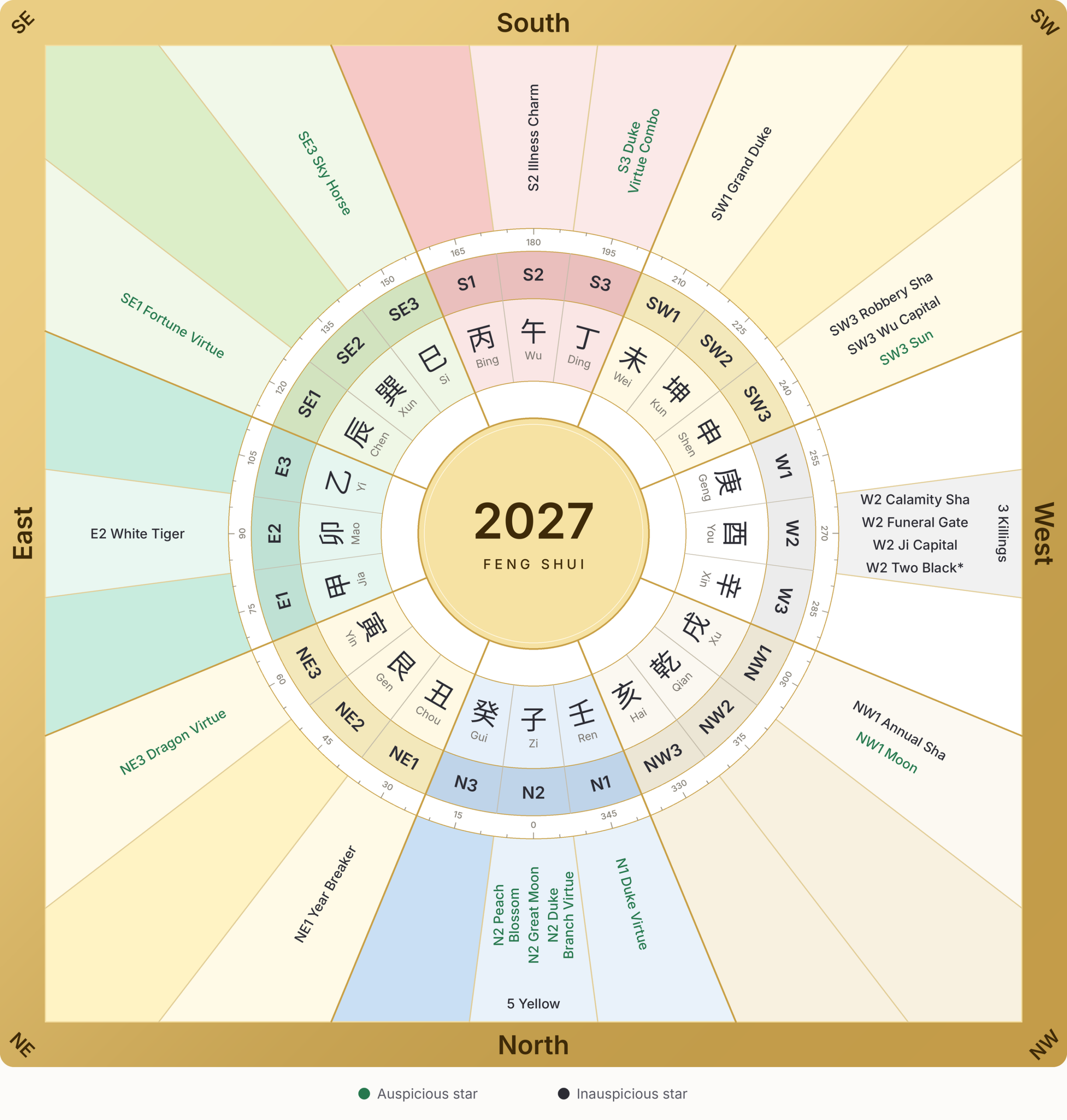
The Stars and afflictions for the year 2027